
Local Interaction Signal Analysis

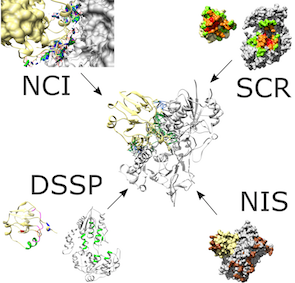
Local Interaction Signal Analysis (LISA) is an empirical function designed to estimate protein-protein binding affinities. It explores the geometry of contact distributions at protein-protein interfaces and enables to identify hot-sites of favorable contacts playing a major contribution in binding affinity. LISA applies to a large variety of complexes resulting in a very stable behavior. It outperforms all existing comparable predictor methods predicting binding affinity.The Analytical Genomics team.Link to the article. 

0 Comments

Faculty of 1000

The article:Raucci R, Laine E, Carbone A. Local Interaction Signal Analysis Predicts Protein-Protein Binding Affinity, Structure, 2018  [ Link to the article ]has been recommended in F1000Prime as being of special significance in its field by F1000 Faculty Member Alexandre Bonvin. 

0 Comments

IFOM and CQB

In the framework of their cooperation, IFOM (Milan) and CQB (Paris) have set up a scientific rotation program specifically targeted to PhD students.Students can spend three months in a host group on a scientific topic, with the goal of exploring new approaches and contexts,and acquiring new skills.Here you can find general rules and how to apply.Here you can find a list of currently posted projects ( you can also apply spontaneously outside of posted projects).Contact: phd-rotation@ifom.eu

0 Comments

Educating through research immersion

Several members of LCQB co-authored « Meet-U: educating through research immersion », which appeared in PLOS Computational Biology on 03/15/2018. Meet-U is a new educational initiative that aims to train students for collaborative work in computational biology and to bridge the gap between education and research. Meet-U mimics the setup of collaborative research projects and takes advantage of the most popular tools for collaborative work and of cloud computing. Students are grouped in teams of 4–5 people and have to realize a project from A to Z that answers a challenging question in biology. In this paper, we report on our experience with Meet-U in two French universities with master’s students in bioinformatics and modeling, and with protein–protein docking as the subject of the course. To the Article

0 Comments

 Hepatitis C Virus fusion mechanism

"A protein coevolution method uncovers critical features of the Hepatitis C Virus fusion mechanism" appeared in PLoS Pathogens, from A.Carbone team. This work sheds light on important structural features of the HCV fusion mechanism and contributes to advance our functional understanding of this process. This study also provides an important proof of concept that coevolution can be employed to explore viral protein mediated-processes, and can guide the development of innovative translational strategies against challenging human-tropic viruses.To the Article

0 Comments

Meet-U

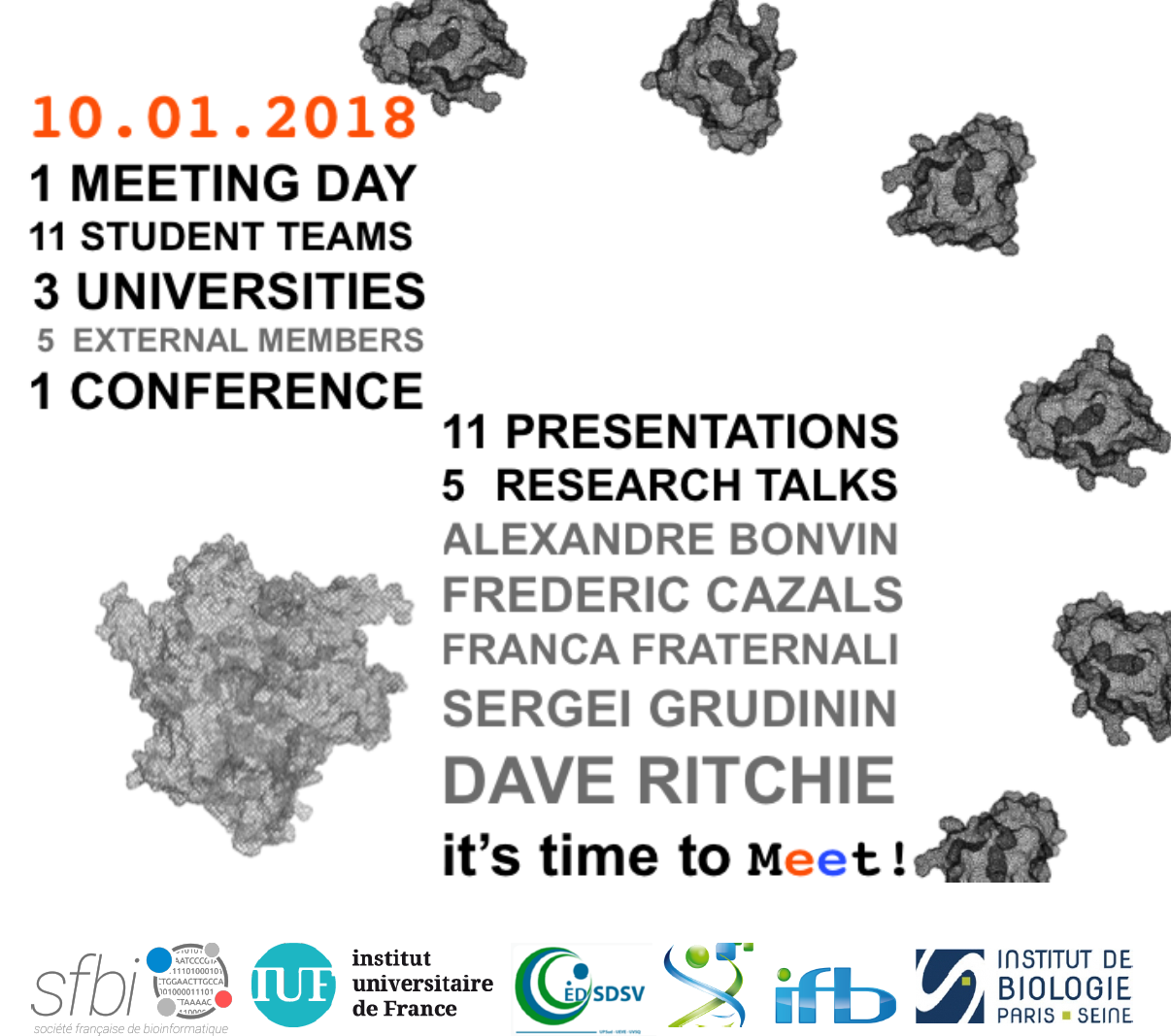
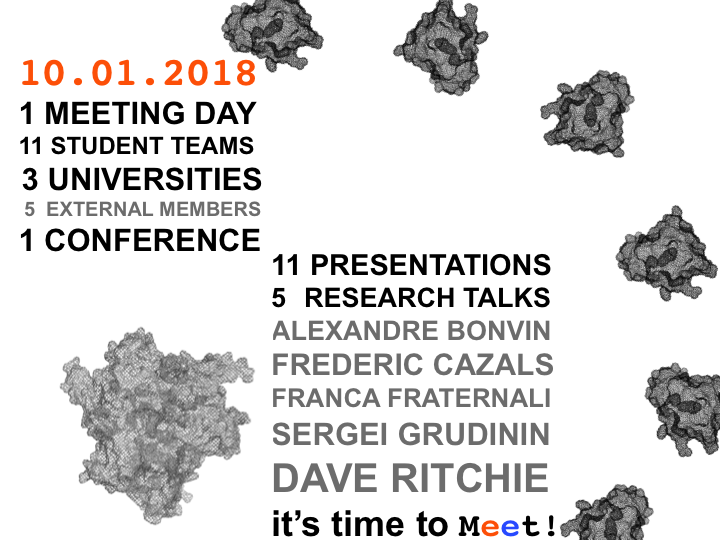
Elodie Laine of the Analytical Genomics team co-organized the Meet-U colloquium on the 10th of January 2018: http://meet-u.org/colloquium_2018.html. Meet-U aims at bridging the gap between teaching and research in computational and quantitative biology. It brings together Sorbonne Université, Univ. Paris-Sud and Univ. Paris-Diderot.The theme of this year was protein-protein docking: http://meet-u.org/edition_2018.html. »

0 Comments

UPMC Young Researchers

Alessandra Carbone and Elodie Laine are organizing the "UPMC Young Researchers' Meeting: Modeling Complex Biological Systems". The talks on current work in computational biology at UPMC will be given by PhD students and Postdocs working at UPMC labs. It will be an opportunity to listen at ongoing research and learn what is done in close by departments.The up to date program is available here 

0 Comments