



MBE
GEMME makes the cover of the MBE november issue.
0 Comments
24 October 2019

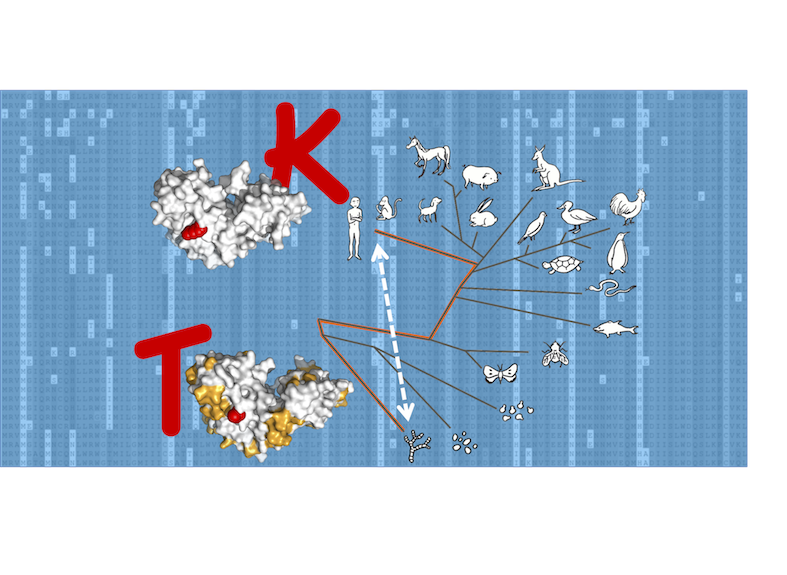
GEMME is a fast, scalable and simple method to predict mutational landscapes from natural sequences. It demonstrates how deleterious effects of a protein mutation are identified by looking at the closest known sequence accepting the mutation in the evolutionary tree of sequences and at its epistatic changes. The article just appeared in Molecular Biology and Evolution.Link to the articleLink to the webserver
We propose the concept of "interacting region" and the dynJET2 method toward deciphering the complexity underlying protein surface usage and deformability. Interacting regions account for the multiple usage of a protein's surface residues by several partners and for the variability of protein interfaces coming from molecular flexibility. dynJET2 predicts interacting patches by crossing evolutionary, physico‐chemical and geometrical properties of the protein surface with information coming from complete cross‐docking (CC‐D) simulations. Link to the Article

What can proteins tell us about how they interact and function together? At LCQB, we develop computational approaches to predict protein interactions, model protein social behaviour and infer the effect of mutations on protein interaction networks. We just posted this video explaining these ideas to the large public. Link to the french videoLink to the italian video
Sarti E., Aleksandrova A., Ganta S., Yavatkar A., Forrest L. Nucleic Acids Research (2019)
Vicedomini R., Bouly J., Laine E., Falciatore A., Carbone A. Preprint (2019)
Saad C., Noé L., Richard H., Leclerc J., Buisine M., Touzet H., Figeac M. BMC Bioinformatics (2018)
⚙️ Site en cours de recette technique
Version de démonstration — certaines fonctionnalités peuvent être incomplètes.
⚙️ Website under technical review
Demo version — some features may be incomplete or temporarily unavailable.