
Nonribosomal peptide synthetases

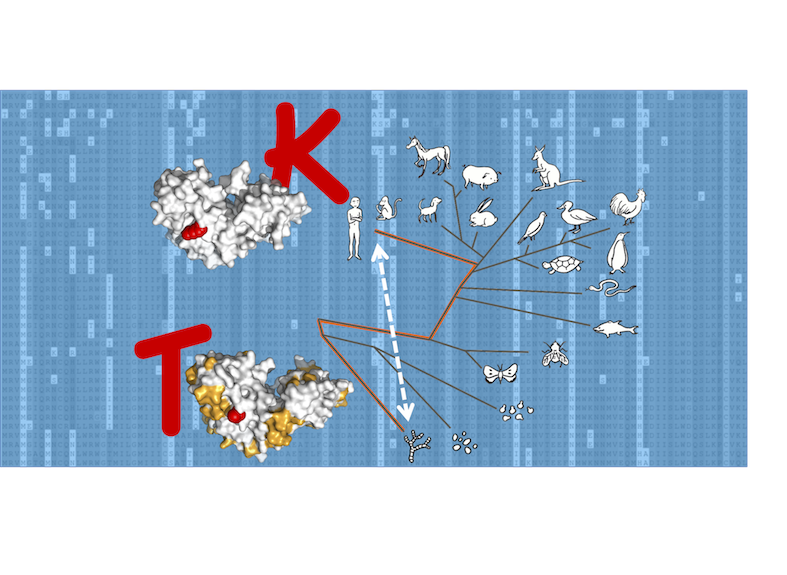
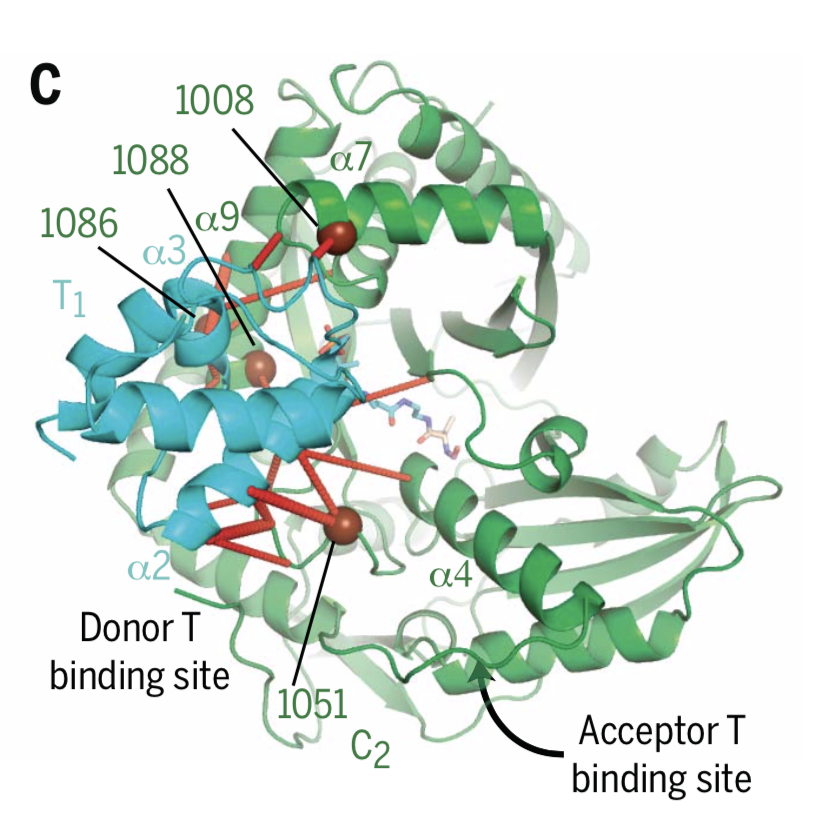
Nonribosomal peptide synthetases (NRPSs) are microbial megaenzymes that make a wide variety of small-molecule products, including many that are clinically used as antitumors, antibiotics, or immunosuppressants. Peptide synthesis proceeds with assembly-line logic, where each station on the NRPS assembly line is a multidomain unit called a module. While the function of single modules is well studied, much less is known how they work together. Researchers from the Schmeing lab at McGill University have resolved several dimodular NRPS structures, which show coordinated interactions between modules, and large conformational changes between catalytically relevant states. Martin Weigt from the “Statstical Genomics and Biological Physics” team has performed complementary coevolutionary analyses using the direct coupling analysis (DCA), which confirm the biological relevance and evolutionary conservation of the observed inter-modular interactions. DCA analysis has also allowed to suggest mutations in a module-swapped chimeric NRPS protein, which significantly increased the activity of the protein, a result of direct…

0 Comments

6th Cross Disciplinary Genomics

The “6th Cross Disciplinary Genomics: from Single Cells to Omics” will be held on November 14-15, 2019, at Amphitheatre 25 – Campus PMC, Sorbonne Université.There is no participation fee but registration is required. 

0 Comments

Que peuvent nous dire les protéines

  Que peuvent nous dire les protéines sur la manière dont elles interagissent et fonctionnent ensemble? Au LCQB, nous développons des approches computationnelles pour prédire les interactions protéiques, modéliser le comportement social des protéines et en déduire l’effet des mutations sur les réseaux d’interaction protéique.  

0 Comments

Cosa possono dirci le proteine

Cosa possono dirci le proteine su come interagiscono e lavorano insieme? Al LCQB sviluppiamo approcci computazionali per predire interazioni proteiche, per modellare il comportamento sociale delle proteine e per dedurre l'effetto delle mutazioni sulle reti di interazione proteica.

0 Comments

GEMME

GEMME is a fast, scalable and simple method to predict mutational landscapes from natural sequences. It demonstrates how deleterious effects of a protein mutation are identified by looking at the closest known sequence accepting the mutation in the evolutionary tree of sequences and at its epistatic changes.  The article just appeared in Molecular Biology and Evolution.Link to the articleLink to the webserver

0 Comments

interacting region

We propose the concept of "interacting region" and the dynJET2 method toward deciphering the complexity underlying protein surface usage and deformability. Interacting regions account for the multiple usage of a protein's surface residues by several partners and for the variability of protein interfaces coming from molecular flexibility. dynJET2 predicts interacting patches by crossing evolutionary, physico‐chemical and geometrical properties of the protein surface with information coming from complete cross‐docking (CC‐D) simulations. Link to the Article

0 Comments